Our Story
Where every child’s potential finds a pathway
From underserved tribal communities in Tripura to children in urban Bengaluru, GITF is building pathways to quality education, personal growth, and a future filled with possibilities. We impart holistic education and enabling skill development to empower tribal and rural India
Great India Talent Foundation
Vision
To create a large learning community with features of comprehensive rural development through education and skill development.
Mission
GITF aspires to educate, enable, and empower children of rural communities in India by setting up multiple educational institutions that will provide them with the options to pursue higher education in their fields of interest.
Objective
The Great India Talent Foundation works to make quality education a reality for children in rural and tribal India. We do this by building free schools and institutions that meet every need of learning: lessons, meals, books, uniforms and care. Our aim is a continuous path of learning, from primary school to higher and vocational education.
A school built around the child
The Rationale Behind GITF
Envisaging equitable and quality education to make India a 5$ trillion economy
Quality education and skilled workforce is the foundation of the economic, social, cultural, scientific growth and the well-being of every nation. World Bank and OECD research reports, over the last few years have outlined the correlation between the quality of education and the economic growth in different countries across the world. Realizing the fact that education is the biggest economic amplifier, progressive countries spend nearly 6% of their public expenditure on School Education and an additional 3% of their public expenditure on Higher and Technical Education. In the initial stages of growth, countries like South Korea have spent upto 25% of their public expenditure on Education. India spent 4.6% of its GDP on Education in total in the recent years, and proposes to increase it to 6%.
The New Education Policy (NEP 2020) intends to bring a paradigm shift from ‘quantity’ to ‘quality’ in the education system. According to Dr K Kasturirangan, Chairman of New Education Policy, quality education requires constant investments into academics, upgradation of infrastructure including libraries, laboratories and other facilities, introduction of new courses, investments in training of teachers, funding for innovation and research, and more.
The UNESCO GEM Report 2024/25 finds that India has largely succeeded in getting children into school, achieving near-universal primary enrollment. However, a lot of work can be done in enhancing the learning outcomes, foundational literacy and numeracy. The report argues that improving educational quality requires stronger leadership at all levels of the education system, better support for teachers, and greater attention to learning rather than enrolment alone. For India, the message is clear: the next phase of educational reform must focus on quality, learning, and leadership.
Our progress as a nation directly corresponds with our ability to harness the potential of 68.84 percent of the population that lives in rural areas. If we are to realise this, we need to further inclusive growth, wherein the rural population, especially children and youth, are empowered through training, education, and skill development.
The Great India Talent School (GITS) is the first programme of GITF. It is an initiative to ensure no child is left behind in the pursuit of education for all. GITS is in collaboration with the Government of Tripura, The Akshaya Patra Foundation, donors, and the local community. It is alignment with five Sustainable Development Goals of the United Nations.
A community rebuilding
Why story behind our first school in Tripura
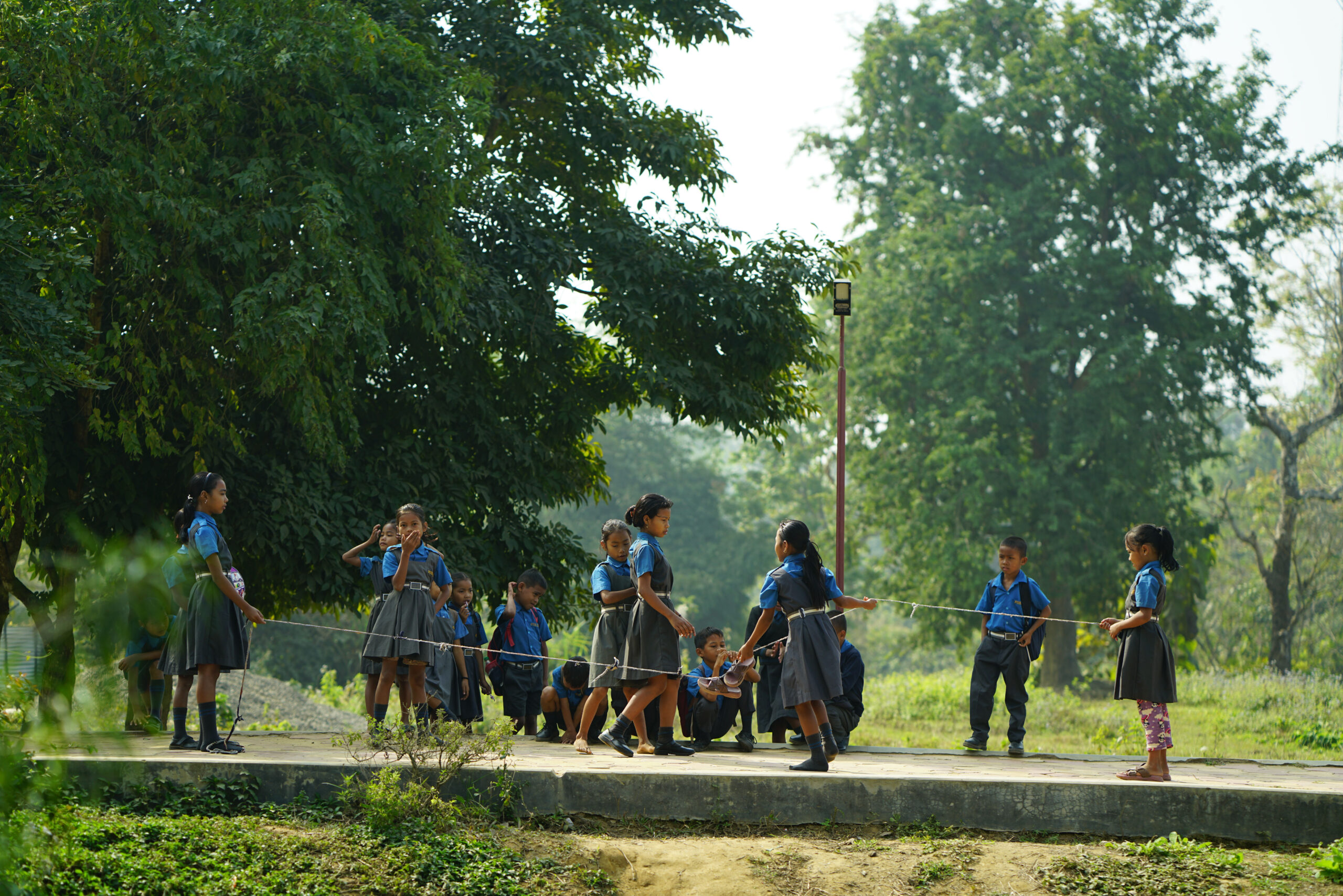
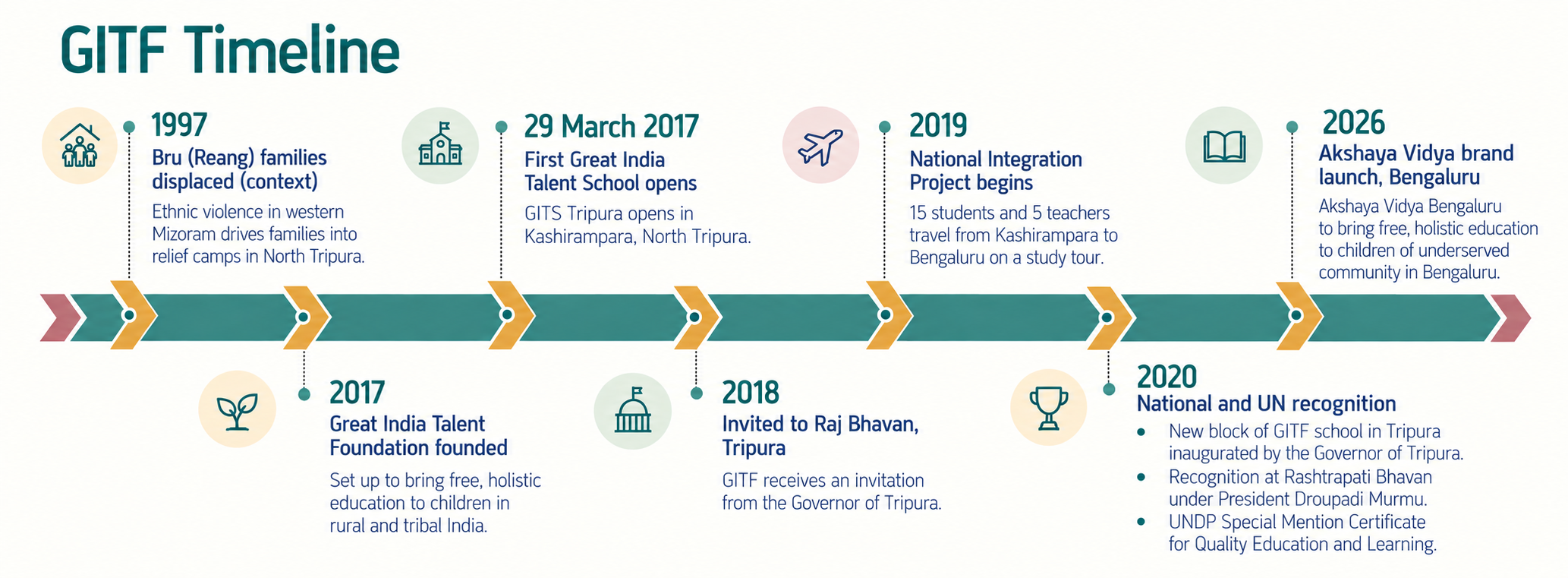
In 1997, ethnic violence in western Mizoram forced thousands of Bru families to leave their homes. For more than two decades, they lived in relief camps in North Tripura, among them Naisingpara and Ashapara.
In 2020, an agreement between the Government of India, the governments of Mizoram and Tripura, and Bru representatives opened the way for families to settle permanently in Tripura. A community that had waited a generation for stability began to rebuild.
Through those years, children grew up with uncertain access to school. The nearest classroom was often far away. Lessons were taught in a language that was not their own. A full meal was not guaranteed.
A school built around the child
On 29 March 2017, GITF opened the Great India Talent School — Mahan Bharat Pratibha Vidyalaya — in Kashirampara. Education here is free, and so is everything that makes learning possible: textbooks, notebooks, uniforms, shoes, sweaters, school bags, and a freshly cooked mid-day meal.
The school follows the CBSE curriculum in English, using Macmillan textbooks — the same standard of learning available to children in India's cities. Regular medical camps bring health check-ups and immunisations to students and teachers alike. We employ the parents of our students. This strengthens household stability and gives the whole family a stake in a better future. This also ensures that the community also grows.
A school the community shapes
GITS is a community effort. Local men and women work as teachers and kitchen staff, and Reang women take an active part in school life. Teachers grow their practice through training led by Macmillan Education Trust.
With schooling secured, families can direct their time and resources toward other priorities — their livelihoods, their homes, their futures.
Through the National Integration Project, GITS students travel to learn from India beyond their hills. In 2019, a group of students and teachers journeyed from Kashirampara to Bengaluru, exploring science and tinkering labs, meeting peers, and returning home with new questions and new ambitions.
The road ahead
The work is far from finished. Students who complete Class 8 at GITS Tripura can continue their schooling in Guwahati with GITF’s support. Moving on to secondary school never has to mean leaving learning behind.
The same promise now reaches beyond the Northeast. In Bengaluru, Akshaya Vidya offers children from low-income urban families free education, along with meals, uniforms and learning materials. GITF’s second school shows that the model travels.
Next, GITF plans to bring this model to more states. Alongside that growth come more classrooms, residential schooling, technology-enabled learning, and training for local youth to become teachers.